Weight Neutral Care in the Doctor’s Office
Every few months, a client tells me about a GP appointment that left them feeling invalidated, ashamed, or dismissed.
Despite clearly explaining that they are in treatment for an eating disorder, the doctor decided it was appropriate to raise weight loss.
To be clear, I am not talking about clients with low body weight anorexia where weight monitoring or discussion may be clinically indicated and part of a coordinated treatment plan. I am talking about clients in larger bodies - often with bulimia, binge eating disorder, or atypical anorexia - for whom weight loss advice is not only unnecessary, but actively harmful.
I understand that most GPs are trying to be helpful. Their training encourages them to see weight as a key marker of health (it isn’t a reliable one, by the way). But training in eating disorders is often minimal, and training on the harms of weight stigma in healthcare is typically absent altogether. When weight loss is raised clumsily or reflexively, it can do real damage: it reinforces weight stigma, undermines eating disorder recovery, and can worsen symptoms. It can also stop people from returning to their GP, or from getting care for the issue they actually came in with.
And while I might hear about this every four or five months in my own practice, I know the reality is much bigger than that. This happens every single day in medical settings. Weight stigma is not an exception in healthcare; it is a feature of the system.
Why this is such a problem for people with eating disorders
For someone recovering from an eating disorder, weight-focused care can:
Trigger restriction, purging, compulsive exercise, or body checking
Create shame and undermine trust in healthcare providers
Create confusion when medical advice conflicts with treatment goals
Reinforce the idea that weight is the most important marker of health
This is particularly harmful given what we already know:
People can be medically unwell at any weight
Weight loss is not a benign or neutral recommendation for someone with an eating disorder history
Health is far more complex than a number on a scale
Dieting and weight loss efforts can trigger the onset of an eating disorder
Many clients tell me they freeze in appointments. They want to advocate for themselves, but the power imbalance, time pressure, and fear of being labelled “difficult” make that incredibly hard.
So I wanted to create something that helps bridge that gap.
Free resource: A weight‑neutral GP card
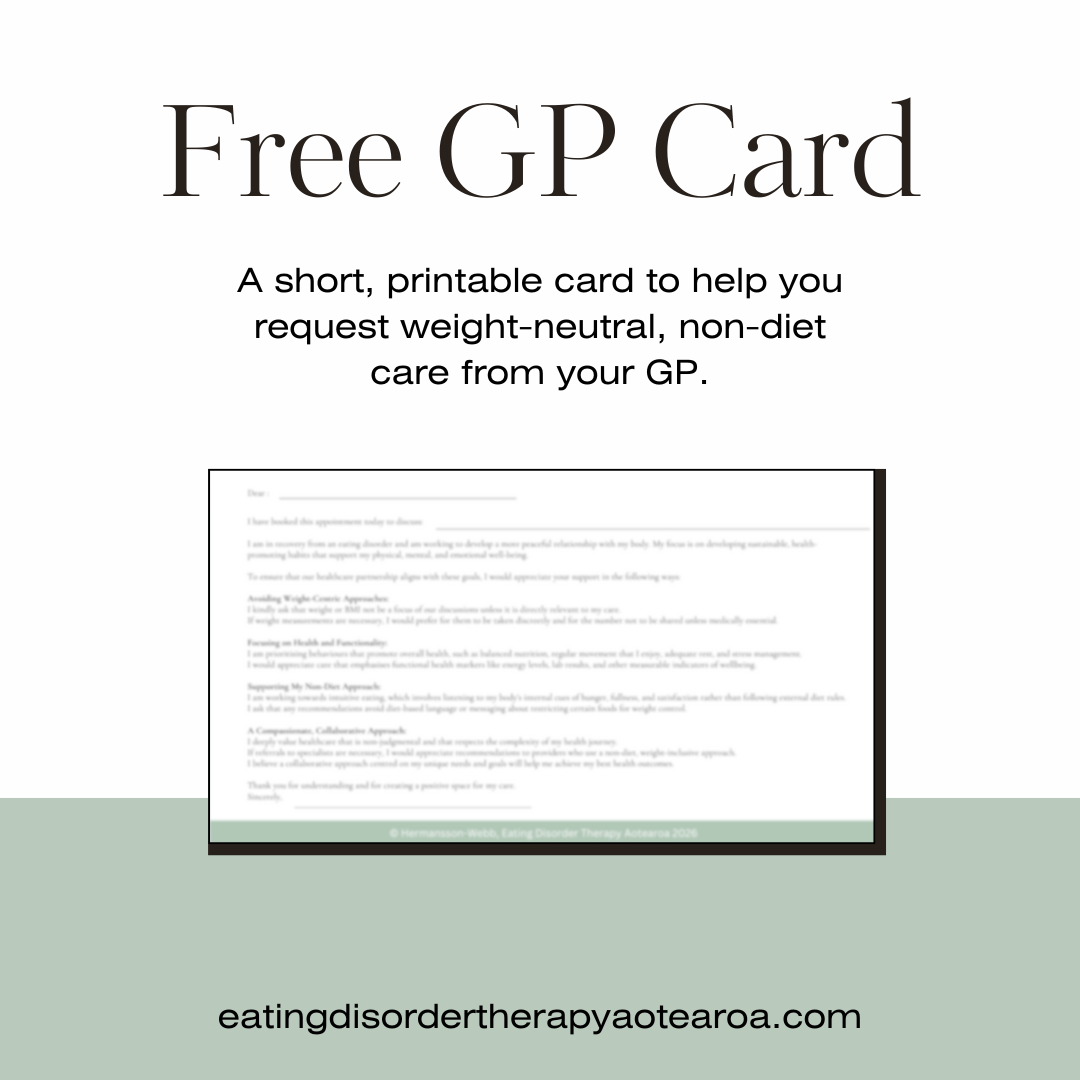
I’ve created a simple, printable card that can be handed to a GP at the start of an appointment.
It clearly and respectfully communicates:
That the person is in eating disorder recovery
That they are seeking non‑diet, weight‑neutral care
How weight can be handled (or not handled) during appointments
A preference for health markers beyond weight and BMI
The importance of compassionate, collaborative care
It’s not about telling doctors how to do their job. It’s about giving patients language; especially when they’re anxious, vulnerable, or worried they won’t be taken seriously.
Why a card?
Because self‑advocacy is much harder when:
There is a clear power imbalance n the relationship
You’re already activated or ashamed
You’re worried about being judged
You don’t want to derail a short appointment
A card allows someone to:
Set boundaries without having to explain or justify themselves
Communicate clearly even if they feel overwhelmed
Focus the appointment on care that supports recovery
Some clients might use it every time. Others might keep it in their wallet “just in case.” Both are valid.
A note to medical professionals
If you’re a GP or health professional reading this: many people deeply want a trusting relationship with you.
Weight‑neutral, non‑diet care is not about ignoring health. It’s about recognising that weight‑centric approaches can cause real harm; particularly for people with eating disorders, disordered eating, or a long history of weight stigma.
Listening, collaborating, and broadening how we define health can make an enormous difference.
Excellent, weight‑inclusive GPs do exist. I know of several Health At Every Size–aligned GPs locally, and my clients consistently describe feeling safer, more believed, and more willing to seek care when their health is approached without weight judgement.
Download the free card below.
You are welcome to download, print, and share this card.
It’s free
It’s confidential
It’s designed to support recovery
If this resource helps even one person feel safer in a medical appointment, it’s done its job.
And if you’re someone who has been harmed by weight‑focused medical care: you’re not imagining it, you’re not overreacting, and you deserve better.